Budget and prices
What a premium face cream actually costs per use
Price per jar hides the figure that matters. Divide by millilitres, multiply by your real dose, and a $180 jar turns into $3.60 a day and $1,314 a year.
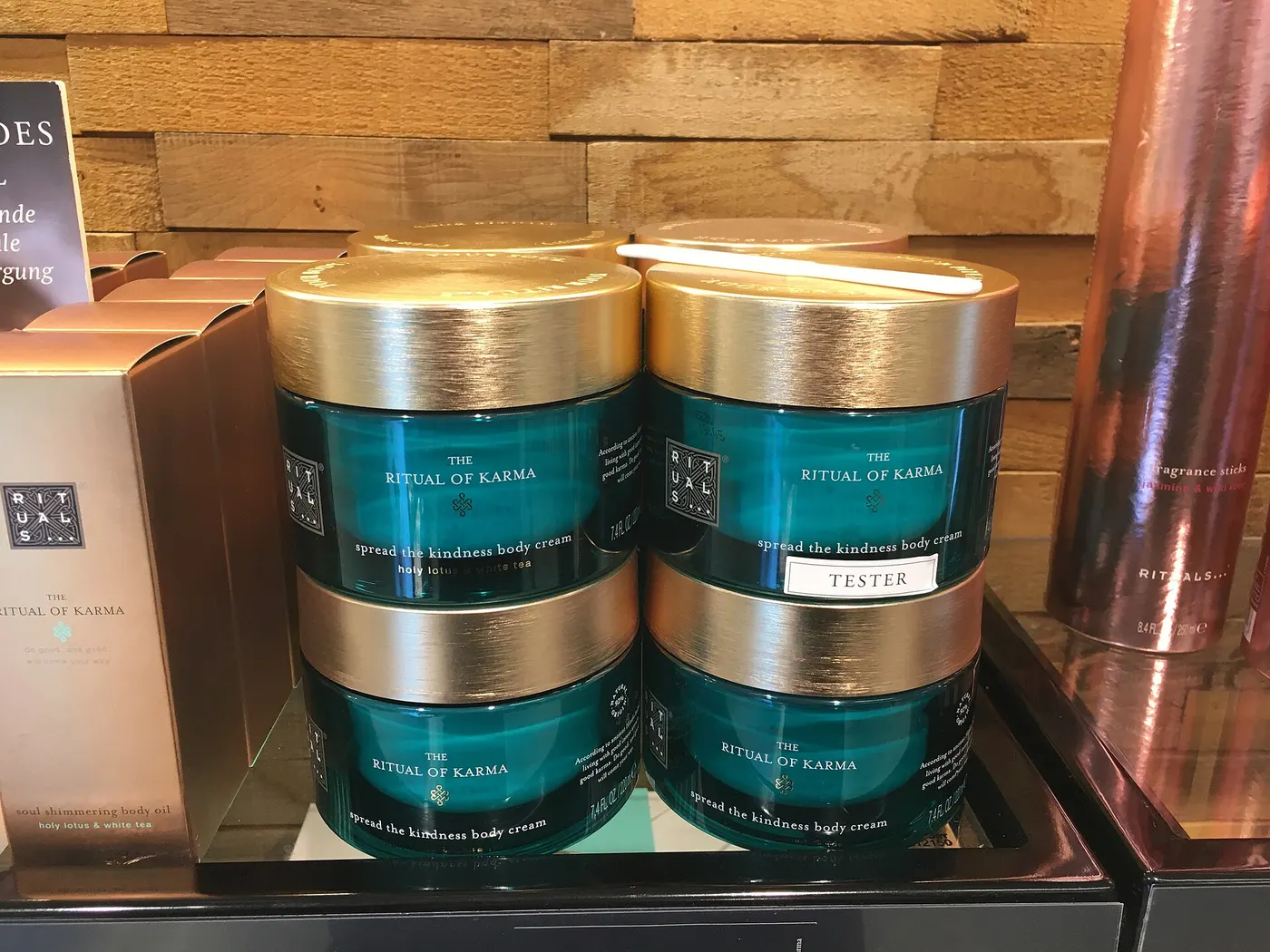
Skincare is the only shelf in a shop where the price is printed and the quantity is in small type on the back. A $180 jar and a $40 jar sitting side by side can hold the same 50 mL or they can differ by a factor of two, and nothing about the box makes that comparison for you.
This guide does one piece of arithmetic in public: price divided by millilitres, multiplied by the dose you actually use, multiplied by how often you use it. Every price here is a labelled example rather than a quote, because this site carries no price feed and no affiliate relationships.
Price per millilitre is the only comparable number
Net quantity of contents is a required element on a cosmetic label in the United States, declared in weight, volume, measure or numerical count. That requirement is what makes the comparison possible at all: every jar on the shelf is obliged to tell you how much is inside, usually in millilitres or fluid ounces.
Divide and the shelf reorders itself. An example $40 jar of 50 mL is $0.80 per millilitre. An example $180 jar of the same size is $3.60 per millilitre. An example $400 jar is $8.00. Those are the three figures that can be compared, and none of them is the one printed on the front.
Larger containers are not automatically cheaper per millilitre, and when they are, the saving can be undone by what happens next. An example $300 jar holding 100 mL is $3.00 per millilitre, which beats the $180 jar at $3.60 — but it also has to last twice as long in your bathroom, and that is a different kind of cost.
| Example price | Per millilitre | Per 0.5 mL application | Per day at twice daily | Per year |
|---|---|---|---|---|
| $40 | $0.80 | $0.40 | $0.80 | about $292 |
| $180 | $3.60 | $1.80 | $3.60 | about $1,314 |
| $400 | $8.00 | $4.00 | $8.00 | about $2,920 |
Each row divides the price by 50 mL, then applies a 0.5 mL dose twice a day, which is 1 mL a day and 365 mL a year. The 0.5 mL dose is a stated assumption, not a manufacturer figure.
The dose is yours, and it is the figure that moves most
The arithmetic above assumes 0.5 mL per application, a dose roughly the size of a small pea for a face and neck. If you actually use 0.25 mL, every figure halves: the $180 jar becomes $1.80 a day and about $657 a year, and the jar lasts 100 days instead of 50.
That is the finding most buyers never make. Moving from the $180 jar to the $40 jar saves $2.80 a day on the figures above. Halving your dose on the $180 jar saves $1.80 a day without changing products at all. Dose and price are both levers, and only one of them requires a purchase.
Doses also differ by product type, which is why a routine total needs each product counted separately. A serum applied once a day at 0.3 mL from a 30 mL bottle lasts 100 days: at an example $90 that is $0.90 an application, about $329 a year. The routine-cost calculator on this site takes each product's volume, price and dose so the total is built rather than guessed.
- 0.5 mL twice a day from a 50 mL jar: the jar lasts 50 days, 7.3 jars a year
- 0.25 mL twice a day from the same jar: it lasts 100 days, 3.65 jars a year
- 0.3 mL once a day from a 30 mL serum bottle: the bottle lasts 100 days
- An example $90 serum on that pattern is $0.90 an application and about $329 a year
- Weighing or measuring your dose once tells you which column of the table above you are in
How long a jar can sit open before the saving disappears
A container that lasts longer is only cheaper if you finish it. There are no U.S. laws or regulations that require cosmetics to have specific shelf lives or expiration dates on their labels, so the date you would check is often not printed. Manufacturers usually recommend discarding mascara two to four months after purchase, and eye-area products are the shortest-lived category.
Handling shortens the life of the rest. FDA notes that dipping fingers into a product adds microorganisms such as bacteria and fungi, and that heat can make preservatives break down, which is why a jar left in a hot car is a different product afterwards. Sharing makeup, FDA says plainly, may mean sharing an infection.
Put that against the arithmetic above and the large jar loses some of its advantage. The example $300 jar of 100 mL at $3.00 per millilitre beats the $180 jar on price, but at a 0.25 mL dose twice a day it takes 200 days to finish, over 6 months of being opened twice daily. The cheaper unit price is real; the question is whether the last third of it is still worth using.
| Container | At 1 mL a day | At 0.5 mL a day | Example price per mL |
|---|---|---|---|
| 30 mL serum bottle | 30 days | 60 days | $3.00 at an example $90 |
| 50 mL cream jar | 50 days | 100 days | $3.60 at an example $180 |
| 100 mL cream jar | 100 days | 200 days | $3.00 at an example $300 |
Days are volume divided by daily use. The 100 mL jar is the cheapest per millilitre in this table and the slowest to finish, which is the trade this section is about.
Sales tax, shipping and the price you really paid
Sales tax in the United States is set by state and locality rather than nationally, so the figure on the product page is not the figure that leaves your account. At an example combined rate of 8 percent, the $180 jar costs $194.40, which moves the per-millilitre figure from $3.60 to $3.89 and the annual total from about $1,314 to about $1,419.
Shipping does the same thing in a lumpier way. A $12 delivery charge on a single $180 jar adds $0.24 per millilitre, a 7 percent increase, while the same charge spread across three jars adds $0.08 per millilitre. That is the entire mechanism behind free-shipping thresholds, and it is worth computing rather than reacting to.
Imported products add duty and carrier handling fees assessed on arrival, which is what the landed-cost calculator on this site exists to capture. Put the delivered total into the per-millilitre division rather than the listed price, and two products that looked equal on their pages usually stop being equal.
Before you buy
- Find the net quantity of contents on the back of every product you are comparing
- Convert everything to the same unit, remembering 1 fluid ounce is about 29.6 mL
- Divide price by volume to get a price per millilitre for each candidate
- Measure your own dose once rather than estimating it
- Multiply dose by applications a day to see how many days a container will last
- Add your own combined sales tax and any shipping before dividing
- Check whether you will finish the larger container within a few months of opening it
Questions readers ask
- Is an expensive cream ever worth it on the arithmetic?
- The arithmetic does not answer whether a formula suits you; it tells you what the decision costs. An example $180 jar of 50 mL at 1 mL a day is $3.60 a day and about $1,314 a year, against $0.80 a day and about $292 for a $40 jar of the same size. That $1,022 annual difference is the figure the decision is actually about.
- How do I know what dose I actually use?
- Measure it once. Dispense your normal amount onto a small kitchen scale or into a marked spoon and note the figure. The difference between 0.25 mL and 0.5 mL doubles every cost in this guide and halves how long a jar lasts, so one measurement is worth more than any amount of estimating.
- Why do you quote millilitres when the label says fluid ounces?
- Either works as long as you are consistent, and 1 fluid ounce is about 29.6 mL. Net quantity of contents is a required label element, so the number is always there in one unit or the other. Convert everything to one unit before dividing, because the comparison fails silently if you mix them.
- Should I buy the biggest jar to get the lowest price per millilitre?
- Only if you will finish it while it is still good. The example 100 mL jar at $3.00 per millilitre beats the 50 mL jar at $3.60, but at 0.5 mL a day it takes 200 days to empty. FDA points out that dipping fingers in adds bacteria and fungi and that heat breaks preservatives down, so a slow jar is a different proposition from a fast one.
- Do cosmetics have to carry an expiration date?
- No. FDA states there are no U.S. laws or regulations requiring cosmetics to have specific shelf lives or expiration dates on their labels, and treats determining shelf life as the manufacturer's responsibility. Manufacturers usually recommend discarding mascara two to four months after purchase, which is the clearest published interval for any category.
Sources
- U.S. Food and Drug Administration — Cosmetics Labeling Guide: net quantity of contents, ingredient declaration and minimum type size requirements — checked 2026-11-03
- U.S. Food and Drug Administration — Shelf Life and Expiration Dating of Cosmetics: no required expiration dating, mascara discard interval, and how handling and heat shorten shelf life — checked 2026-11-03
Some links on this site can earn us a commission. That does not change which product a guide recommends, and it adds nothing to your price. Advertising is not enabled on this site yet. When it is, ads will be labelled and kept visually separate from the guides.